
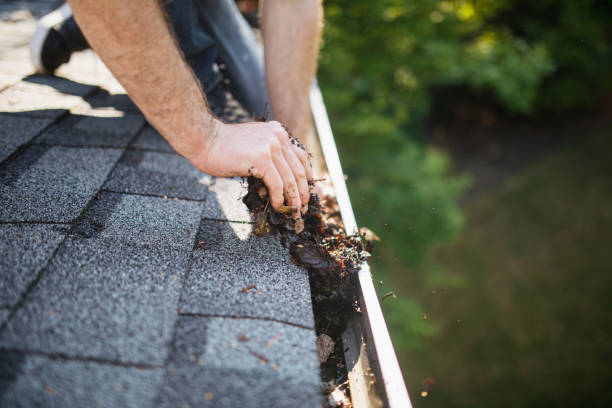

Someone knocks on your door, or you see the ad online. Install gutter guards once, and you’ll never clean your gutters again.
It’s a good pitch. Nobody enjoys this job, and the idea of being done with it forever is appealing.
The truth is somewhere in the middle. Gutter guards do real work, and for some homes they’re worth every dollar. But “never clean them again” isn’t accurate, especially in Florida. Here’s what’s actually going on.
The Main Types, and What They Cost
Not all guards are the same, and the gap between the cheap ones and the expensive ones is big.
Foam inserts are the cheapest. You push a wedge of foam into the gutter and debris sits on top. They run a few dollars per foot and you can install them yourself. They also break down in UV light, which in Florida means a few years at best.
Plastic or metal screens are the common middle option. These are panels with holes or slots that sit over the gutter. Installed, they typically run somewhere in the range of $3 to $8 per foot.
Micro-mesh guards are the fine stainless steel ones. The openings are small enough to block most debris while letting water through. These are the good ones, and they’re priced accordingly: usually $10 to $25 per foot installed, sometimes more with the big national brands.
Reverse-curve systems use surface tension, letting water curl around the edge while debris falls past. They work, but they’re visible from the ground and they struggle in very heavy rain, which matters here.
For an average home with 150 to 200 feet of gutter, a quality micro-mesh job often lands in the $2,000 to $4,000 range. That’s a real decision, not a small purchase.
What They Genuinely Do Well
Guards are good at one specific thing: keeping large debris out.
Oak leaves, small branches, pieces of palm, seed pods. All of that stays on top of the guard instead of filling the channel below. For a home surrounded by big trees, that’s a meaningful change. A gutter that used to pack solid every few months might stay mostly clear for a year or more.
They also stop birds and squirrels from nesting in the gutter, and they keep water from standing in the channel, which cuts down on mosquitoes. In Florida, both of those count for something.
And they reduce how often someone needs to be on a ladder, which is worth a lot on a two-story house.
Where the Pitch Falls Apart
Here’s what the ads don’t spend much time on.
Small debris goes right through. Pine needles are the big one. On many guards, needles slip through the openings or wedge into them. Florida also has heavy oak pollen in late winter and spring, and that fine yellow dust passes through almost any guard, settles in the gutter, and turns into a sludge layer once it gets wet.
The guard itself needs cleaning. This is the part people don’t expect. Leaves and needles sit on top of the guard and don’t always blow away. Over time they form a mat. Water hits that mat and runs straight over the edge, so your gutter is clean and your gutter is also useless.
Micro-mesh clogs from above. The fine mesh that keeps debris out also catches pollen and shingle grit. When that film builds up, water beads and sheets off instead of passing through. You usually notice it during the first heavy rain of the season.
Heavy rain can overwhelm them. Florida storms drop water fast. Some guard designs, especially reverse-curve ones, can’t take water in quickly enough during a downpour, so it shoots past the gutter entirely.
A bad installation can hurt. Some systems require lifting the bottom row of shingles, which can affect your roof warranty. Others add weight that loosens the gutter’s brackets over time.
What Really Changes: The Schedule, Not the Job
The honest version of the pitch is this: guards don’t eliminate cleaning, they reduce how often you need it.
Without guards, a Florida home under heavy tree cover often needs cleaning two or three times a year. With good micro-mesh guards, that same home might go to once a year, sometimes once every eighteen months.
That’s a real benefit. It’s just a different promise than “never again.”
It also changes what the cleaning looks like. Instead of scooping a packed channel, the work is usually clearing the top of the guards, lifting panels to check underneath, and flushing the downspouts. Not every crew works with guards, so if you have them, say so when you book gutter cleaning in Florida homes so the right people show up.
Doing the Math for Your House
Whether guards are worth it comes down to a simple comparison.
Figure out what you currently spend on cleaning per year. Then take the installed cost of the guards and divide by your new, reduced cleaning frequency.
If you have few trees and clean once a year, a $3,000 system takes a very long time to pay for itself. If you’re on a two-story house under live oaks and pines, cleaning three times a year, the numbers look much better, and you’re also off the ladder.
Some situations tip the scale on their own: a steep or tall roof, a solar array over the gutter line, or a homeowner who simply shouldn’t be climbing anymore.
Questions Worth Asking a Salesperson
If someone is quoting you a system, these four questions sort out the serious companies fast.
What happens with pine needles and pollen specifically? What’s the maintenance schedule you actually recommend? Does the installation touch my shingles, and what does that do to my roof warranty? What exactly does the warranty cover, and is it transferable if I sell?
A vague answer on any of these tells you something useful.
The Short Version
Gutter guards are a legitimate product that solves a real problem. They are not a way to stop thinking about your gutters.
If you’re going to get them, get good ones, keep a light maintenance schedule, and treat the savings as fewer cleanings rather than none. If you’re not sure the math works for your house, start by comparing what regular gutter cleaning services in Florida cost for your size of home. Sometimes a couple of visits a year is simply the cheaper answer.
Either way, the thing to avoid is installing guards and then ignoring the roofline for five years. That’s how people end up with clean-looking gutters, rotted fascia boards, and a repair bill that dwarfs what they saved. If you’re not certain what’s happening up there, an experienced gutter cleaning crew can tell you in one visit.