

The Category That Seems Simple and Has Real Nuances
Mulch is one of the most broadly recommended garden practices — cover the soil, conserve moisture, suppress weeds, moderate temperature, improve soil as it breaks down. The recommendation is correct as far as it goes, but ‘use mulch’ leaves out the part that determines whether the mulch actually performs these functions: the right mulch in the right application at the right depth.
The range of mulch materials available spans wood chips, bark, straw, shredded leaves, grass clippings, gravel, rubber, and manufactured products — each with a different performance profile for moisture retention, weed suppression, aesthetic character, effect on soil chemistry, and rate of decomposition. Knowing which material serves which application produces better results than the generic ‘apply 2–3 inches of mulch’ recommendation.
Shredded Wood and Bark Mulch: The Standard and Its Variations
Shredded hardwood bark mulch is the most common residential landscape mulch — available in bags or bulk, in fine to coarse grades, and in colors ranging from natural brown to dyed black or red. Quality shredded hardwood mulch decomposes moderately slowly (2–3 seasons), improves soil structure as it breaks down, and provides good weed suppression when applied at 2–4 inch depth.
The dyed color varieties (black, red, brown) use colorants that are generally considered safe but fade significantly after the first season — the vibrant dyed color at application becomes muted within weeks in sun. Natural un-dyed wood mulch is more consistent in appearance over time and avoids any uncertainty about colorant chemistry in organic food gardens. For vegetable gardens specifically, avoid dyed mulch and any treated wood products.
Wood Chips: The Free High-Performance Option
Fresh wood chips from tree trimming operations are the mulch that arborists and landscape ecologists most recommend for garden beds and tree circles. They’re often available free from municipal compost programs or from arborists looking to dispose of chips after trimming — a material with excellent performance characteristics that’s typically given away.
Fresh wood chips (as distinct from processed bagged wood mulch) contain bark, sapwood, and green material at various stages of decomposition. This diversity supports a richer fungal community in the soil than uniform bark mulch does. Research by arborist Chip Budge and others has documented that deep wood chip application (6–12 inches in appropriate applications) dramatically reduces irrigation needs, suppresses weeds more completely than 2-inch bark application, and improves soil biology more significantly than processed mulch products.
Straw: The Vegetable Garden Standard
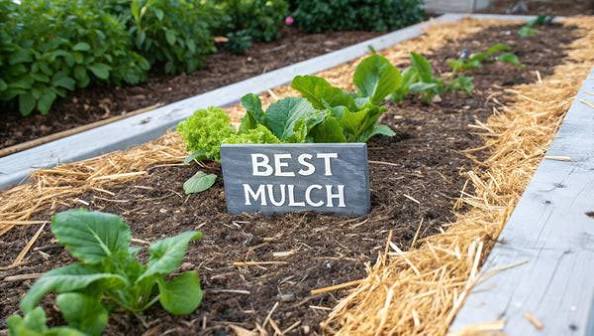
Wheat or oat straw (not hay — hay contains seed heads that sprout prolifically) is the preferred mulch material for vegetable gardens for several reasons: it’s light and easy to work around vegetable plants without damaging them, it warms the soil in spring (dark mulch materials absorb heat; straw reflects some heat while still providing moisture retention), it breaks down within one season returning nutrients to the soil, and it’s inexpensive and widely available at feed stores.
The depth requirement for straw mulch: 4–6 inches, because straw settles significantly after application and rain. At this depth it provides adequate weed suppression and moisture retention. Thinner applications settle into an ineffective thin mat within weeks. The settling is also useful — by the end of the season, the decomposed straw layer can be worked into the soil as a soil amendment.
Gravel and Stone: Permanent Mulch for the Right Applications
Gravel and crushed stone (pea gravel, decomposed granite, river rock, lava rock) are permanent mulch materials that don’t decompose, don’t need annual replenishment, and don’t contribute organic matter to the soil. These characteristics make them appropriate for some applications and wrong for others.
Right applications for gravel mulch: around succulents and Mediterranean herbs that prefer well-drained, low-organic soils (wood mulch in these beds can hold too much moisture and promote root disease in drought-adapted plants), in rock garden applications, around paths and hardscape features where the gravel integrates with the overall design, and in areas where weed suppression without decomposition is the primary goal. Wrong applications: around trees and shrubs that need the soil-building benefit of organic mulch decomposition, in vegetable gardens, and in any application where the visual character of gravel conflicts with the garden’s aesthetic.