
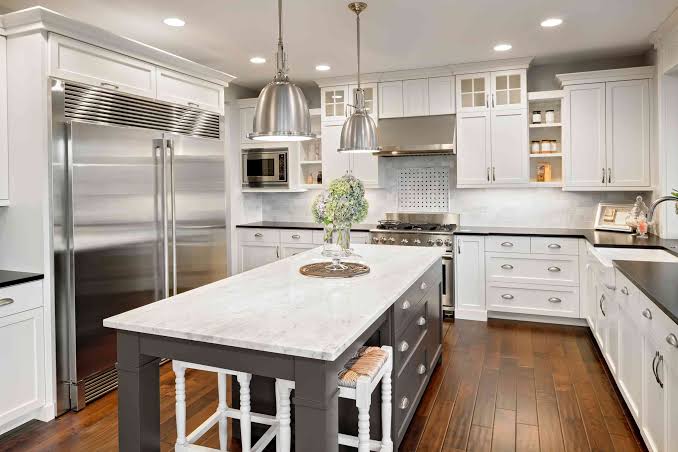

The Room Where Flooring Works Harder Than Anywhere Else
Kitchen flooring faces a specific combination of demands that no other room in the home creates simultaneously: regular water and liquid exposure from cooking, cleaning, and dishwasher steam; heavy foot traffic concentrated in a limited path pattern (the cook’s typical routes between sink, stove, and refrigerator); dropped items including heavy pots and sharp utensils; sustained standing on an unforgiving surface; and the visual requirement of looking clean despite the abuse.
A flooring material that performs well in a living room or bedroom may fail at one or more of these kitchen-specific demands. The selection that works well in the kitchen is determined by the full performance profile rather than by aesthetics alone.
Porcelain Tile: The Maximum Durability Choice
Porcelain tile is the hardest and most durability of common residential kitchen floor materials. It doesn’t scratch, doesn’t dent, doesn’t react to spills, doesn’t absorb moisture, and maintains its appearance under the heaviest kitchen traffic for decades. The grout joints are the maintenance element — sealed properly and cleaned regularly, they’re manageable; neglected, they become the visual deterioration point of an otherwise durable floor.
The comfort limitation covered earlier in this series bears repeating in the kitchen context: porcelain is unforgiving underfoot. An hour of cooking on tile produces more foot and lower back fatigue than equivalent time on cork, LVP, or hardwood. Anti-fatigue mats at the primary standing positions (sink, stove, prep area) address this practically but interrupt the visual continuity of the floor. This is the primary reason porcelain tile, despite its superior durability, isn’t the dominant choice in residential kitchens.
Luxury Vinyl Plank: The Current Dominant Choice
LVP has become the most widely installed residential kitchen flooring material for reasons that align directly with the kitchen’s demand profile: it’s waterproof throughout its thickness (not just at the surface), resists scratch from dropped utensils and dragged chairs, provides a measure of cushioning that reduces standing fatigue compared to tile, cleans easily, and has advanced aesthetically to the point where it credibly replicates wood and stone appearances.
The caveats for kitchen LVP specifically: the expansion gap at all cabinetry bases and walls must be maintained and covered by toe kick trim — gaps that allow water to reach the subfloor under cabinets are where LVP moisture resistance fails in kitchen applications. And the wear layer specification (20 mil minimum for kitchen use) determines how long the floor maintains its appearance under concentrated kitchen traffic.
Hardwood in Kitchens: Possible With Appropriate Expectations
Solid and engineered hardwood in kitchens generates debate among flooring professionals — some consider it inappropriate for the moisture exposure; others point to kitchens with hardwood floors maintained beautifully for decades. The honest assessment: hardwood in a kitchen requires accepting that occasional moisture exposure will affect the finish over time (water from cooking, cleaning, the dishwasher door), that prompt cleanup of any standing water is non-negotiable, and that the floor will require refinishing more frequently than the same wood in a lower-moisture environment.
For households that strongly prefer the warmth and character of real wood and are willing to maintain it appropriately, hardwood in a kitchen is achievable. For households looking for the appearance of wood without the maintenance considerations, quality LVP is the more practical choice.
The Comfort-Durability Matrix
The kitchen flooring decision ultimately sits on a matrix with comfort on one axis and durability on the other. At the maximum durability, minimum comfort corner is porcelain tile. At the maximum comfort, moderate durability corner is cork (moisture-sensitive but comfortable) or hardwood (character-building durability). LVP sits in the high-durability, moderate-comfort zone that explains its dominance. Concrete and natural stone are high-durability, low-comfort options with specific aesthetic appeals.
Matching your position on this matrix to the kitchen’s actual use pattern — how often heavy cooking happens, how often multiple people are in the kitchen simultaneously, how much standing time is typical — produces a better selection than defaulting to either the most durable or the most attractive option without considering how the kitchen is actually used.