
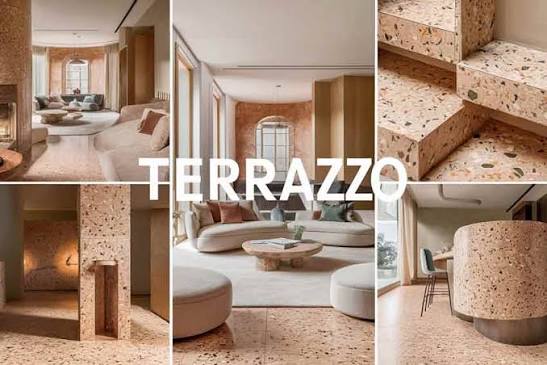

The Floor That’s Been Around for Centuries and Looks New Again
Terrazzo is one of the oldest composite flooring materials in architectural history — the technique of embedding marble chips, glass, or stone in a cement or epoxy binder and grinding the surface smooth to expose an aggregate pattern dates to Venetian craftsmen of the 15th century. It covered the floors of midcentury schools, hospitals, and government buildings through the 1960s, then largely disappeared from residential design as other materials dominated, and has returned prominently in the past decade as one of the defining material stories in contemporary interior design.
The terrazzo available today includes both the traditional cement-based system installed by skilled craftspeople and epoxy-based modern systems that have better performance characteristics, more color and aggregate options, and faster installation timelines than traditional terrazzo.
How Terrazzo Is Made and Why That Matters
Traditional terrazzo is poured in place: a layer of cement is applied to the substrate, chips of marble, granite, glass, mother of pearl, or other aggregate are scattered across the wet surface, and the mix is allowed to cure. The cured surface is ground progressively finer with diamond abrasives until the aggregate is exposed and the surface is smooth. Divider strips (thin metal or plastic strips set in the cement before pouring) create the geometric sections that prevent random cracking and allow color and pattern changes.
Epoxy terrazzo uses a two-part epoxy resin binder instead of cement. It’s thinner (approximately 3/8 inch versus 1/2 to 3/4 inch for cement), more flexible, more stain-resistant, and bonds better to concrete substrates without the moisture concerns that can affect cement terrazzo. It also offers a wider color range in the binder itself, enabling brighter and more saturated palette options than cement allows.
Performance Characteristics: What Makes It Worth Considering
Terrazzo’s performance profile is exceptional in several dimensions. It’s extremely durable — properly maintained terrazzo floors in public buildings have lasted 100 years without replacement, simply requiring periodic repolishing. It’s hygienic — the seamless surface (except at divider strips) has no grout lines where bacteria and dirt can accumulate. It’s heat-resistant and appropriate for radiant floor systems. It’s non-combustible and doesn’t off-gas VOCs once cured.
Its thermal mass is high — terrazzo is cool underfoot in warm weather and holds warmth from radiant heat systems effectively. In regions with cooling needs, this thermal property is a comfort benefit. In cold climates, it’s a reason to consider radiant heat as part of the installation.
The Cost Reality and Where It’s Justified
Terrazzo is among the more expensive flooring options in its installed cost: traditional cement terrazzo typically runs $15–$30 per square foot installed by skilled craftspeople; epoxy terrazzo runs $10–$20 per square foot installed. These costs significantly exceed hardwood, LVP, and ceramic tile, and roughly equal high-end natural stone.
The cost is justified when the design intent includes terrazzo’s specific aesthetic (the aggregate pattern that no other material replicates), when the space will be used heavily for decades (the 50–100-year lifespan changes the cost-per-year calculation dramatically), and when the building is designed or renovated for a long-term vision rather than near-term sale. Terrazzo in a house being sold within 5 years is harder to justify; terrazzo in a forever home is a compelling lifetime investment.
Terrazzo Tile: The Accessible Alternative
For homeowners who want the terrazzo aesthetic without the poured-in-place installation complexity and cost, terrazzo tiles — pre-manufactured tiles of cement or epoxy terrazzo cut to standard dimensions — provide a compromise. They install like standard tile (on mortar bed, with grout joints), cost $5–$15 per square foot, and create the visual character of terrazzo at a price point that competes with quality ceramic tile.
The trade-off from the design perspective is the grout joints — which terrazzo tile inherently has and which poured terrazzo doesn’t. The seamless quality that makes terrazzo distinctive is partially compromised in tile form. For applications where the specific pattern and aggregate aesthetic are more important than the seamless surface, terrazzo tile is a genuinely satisfying alternative.