
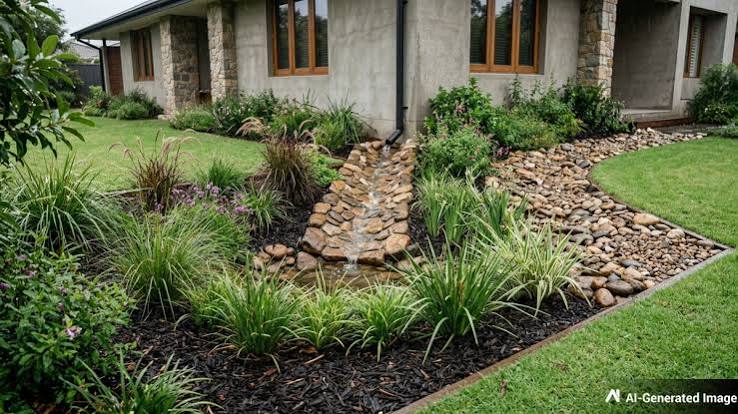

The Problem That Has a Beautiful Solution
Residential drainage problems — water that pools after rain, downspouts that deposit concentrated runoff at the foundation, areas of the yard that stay wet for days after precipitation — are typically addressed through engineered drainage: French drains, dry wells, extended downspout pipes. These solutions work, but they’re invisible and add no value beyond their function.
A rain garden is a planted depression in the landscape designed to receive, hold, and slowly infiltrate stormwater runoff — solving the drainage problem while creating an attractive garden feature with ecological value. The EPA and most state environmental agencies actively encourage residential rain gardens as a low-cost, high-impact approach to reducing stormwater runoff that overwhelms municipal systems after heavy rain.
How Rain Gardens Work
A rain garden is positioned in a low area of the landscape — or an area graded to receive runoff from a downspout, a driveway, or a lawn area. After rain, water flows into the garden and collects in the depression. The garden’s amended soil (a mix of sand, compost, and native soil that infiltrates water faster than typical yard soil) allows the collected water to percolate into the ground within 24–48 hours, recharging groundwater and reducing the volume of runoff that flows to storm sewers.
The sizing rule: a rain garden is typically sized at 20–30% of the impervious surface area it’s draining. A 500-square-foot section of roof draining to one downspout needs a rain garden of approximately 100–150 square feet. Larger rain gardens handle more runoff and infiltrate faster.
Siting and Sizing
The correct location for a rain garden: at least 10 feet from the foundation (to prevent infiltrated water from reaching the foundation), in an area that’s not already chronically saturated (if water doesn’t drain within 48 hours naturally, the soil doesn’t perc adequately for a rain garden), and where it can receive runoff from the intended source (downspout, driveway edge, low point in the lawn) naturally or with minimal grading.
A simple infiltration test confirms site suitability: dig a 6-inch-deep hole, fill it with water, and time how long it takes to drain. Complete drainage within 24 hours indicates adequate infiltration rate for a rain garden. Soil that doesn’t drain within 24 hours needs significant amendment or an alternative drainage solution.
Plant Selection for the Three Zones
A well-planted rain garden has three zones with different water conditions: the bottom of the depression (wet zone — regularly inundated and slow to drain), the side slopes (transition zone — occasionally wet, drying between rain events), and the edges (upland zone — standard garden moisture conditions). Plant selection for each zone determines whether the garden thrives or struggles.
Native plants are the ideal selection for all zones — they’re adapted to the local precipitation patterns that create the wet-dry cycles the rain garden experiences. Wet zone natives: blue flag iris, swamp milkweed, cardinal flower, river birch. Transition zone: switchgrass, joe-pye weed, black-eyed Susan, native ferns. Upland zone: virtually any drought-tolerant native perennial or shrub. Avoid invasive species in any zone — a rain garden creates excellent conditions for vigorous plant growth, including the aggressive growth of invasive plants.
Construction: A Weekend Project With Long-Term Rewards
A basic residential rain garden can be constructed over a weekend with simple tools: a shovel, a rake, a wheelbarrow, and the energy to move soil. Mark the garden’s outline with spray paint or a garden hose. Excavate to the planned depth (typically 6–12 inches below grade). Amend the excavated soil with sharp sand and compost (a ratio of 60% sand, 30% compost, 10% topsoil creates the fast-infiltrating mix rain gardens require). Reshape the excavated area with the amended soil.
Create a flat-bottomed depression with gentle side slopes (3:1 slope ratio — 3 feet horizontal for every 1 foot of depth is gentle enough to prevent erosion). Create a level overflow point on the downhill edge where water can exit if the garden fills beyond capacity during a major storm event — this prevents overtopping damage. Plant immediately to establish root systems before the next major rain event.